7/17/2025
Hands-on with the Festool CSC SYS 50
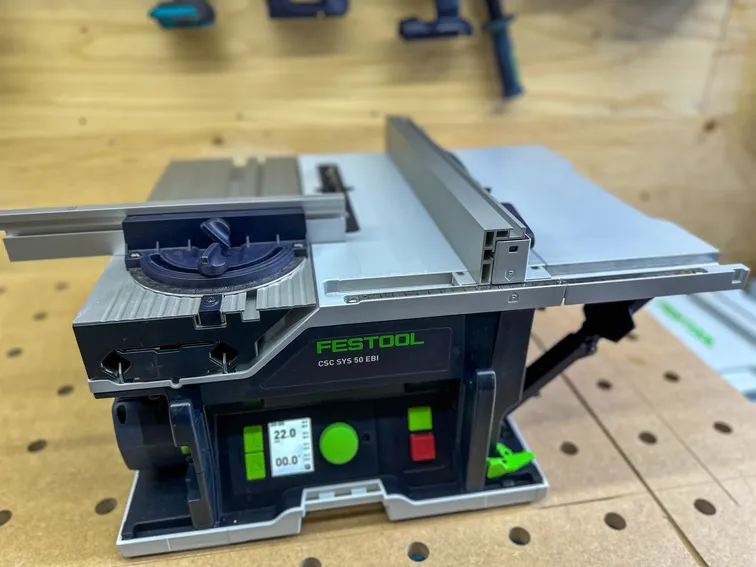
Image by:
hashtagsheepI’ve had my Festool CSC SYS 50 for over 18 months now, and I figured it’s time to share some thoughts and give this little powerhouse a proper shakedown. So let’s get started!
The backstory
At some point, every woodworker hears the inner calling: “Buy a table saw.” It’s the heart of many workshops. But if you’re like me, short on space, it’s a tough tradeoff. Giving up valuable room for a tool that’s nice to have but not essential isn’t a decision to make lightly. I’m talking about jobsite saws here. Anything bigger would just eat the shed and leave no space for me.
After a lot of research (and internal debates), I bought what seemed like a good fit: the Metabo TS 254. I unpacked it only to find the table top was warped. Not just a little. Back to the store. Got a replacement. Same issue.
To be fair, I don’t want to blame Metabo. Maybe I got unlucky or there was shipping damage. But it left me frustrated enough to pause the whole table saw idea for a few weeks.
Then came a tempting offer on the “icon” of jobsite saws: the Bosch Professional GTS 10 XC. Powerful, precise, and the sliding table was a nice bonus. But it was also very large. I made a rolling cart for it, but it always seemed to be in the way. After a year, I sold it and went back to being “table saw-less”.
That’s when I discovered the Festool CSC SYS 50. I wanted something compact, mobile, and clever. A saw that wouldn’t take over the entire shed. Enter: a saw in a Systainer. Small enough for indoor projects, light enough to carry outside for bigger ones.
Was a compact, battery-powered table saw really the tool I wanted and needed at this point? For me, absolutely. I mainly use a table saw for small, repetitive cuts, things that a mitre saw or plunge saw just aren’t great at. And for that kind of work, the CSC SYS 50 fits the bill perfectly. So yes, this little saw has earned its place in my shed.
The basics
Time for some good old-fashioned spec sheet stuff. Don’t worry, I’ll share what all this actually means in the workshop in a moment.
| Feature | Details |
|---|---|
| Type | Cordless table saw (compact format) |
| Form factor | Integrated into a Systainer³ (size M 437) |
| Power source | Dual 18V batteries (36V total) |
| Motor | Brushless EC-TEC |
| Max cutting depth | 48 mm at 90°, 34 mm at 45° |
| Rip capacity | 280 mm |
| Blade diameter | 168 mm |
| Speed range | 4,500 to 6,800 rpm (electronically adjustable) |
| Bevel range | -10° to +47° |
| Digital control | Height, angle, and speed adjustment via display |
| Sliding table | Integrated, supports crosscuts |
| Battery features | Bluetooth-enabled, charge shown on display |
| Dust extraction | Integrated port for dust extractor connection |
| Portability | Fully self-contained in a single Systainer unit |
| Weight | Approx. 15.4 kg (without batteries/accessories) |
The good
- Portability & storage: Festool nailed the format. Everything fits into a standard Systainer, so you can stack it, stash it, or roll it out of the way. It was one of the key reasons I chose this saw.
- Precision: The digital controls are surprisingly useful. Calibrate once, and then just dial in your angle or depth. No guesswork, no extra measuring tools. Battery status on-screen is a nice bonus.
- Sliding table: A built-in crosscut sled, kind of. Makes cuts more accurate and safer, especially with the T-rail clamping options.
- Blade changes: Quick and fuss-free, something I wish more saws got right.
- Bluetooth connectivity: Not essential, but surprisingly clever. Festool’s system lets your cordless tools automatically trigger your shop vac, saving you a trip to the switch. You can also check your saw’s status and adjust your blade presets (angle and height) directly in the app… handy features, even if they feel a bit over the top at first.
- Battery turnaround: Swap and go. Runtime is more than enough for typical shop tasks. A dual charger is a must-have in my opinion, some packages include one, but if not, definitely consider it. You’ll want fresh batteries ready at all times to keep the workflow smooth.
The bad
- It’s different: The compact design means it’s not compatible with standard accessories. The mitre slots, fence, and overall layout require custom solutions. Many jigs won’t work out of the box, though thankfully, some makers are catching up with CSC-compatible options.
- The tiny push stick: Just… no. It’s more of a safety risk than a helper. Get a better one or make your own.
- Pricing: Festool pricing is always a topic. I don’t mind paying for quality, but yes, there’s a bit of a “green tax” here.
The meh
- Power: It’s good, not amazing. I’ve cut 4.5 cm walnut without drama, but blade choice really matters. Keep it sharp and matched to the task.
- Cleaning: The closed design makes it hard to access for cleaning. Dust collects in the case corners, and there’s no easy way to get in deep. If you’re as picky about cleaning as I am, this will bug you.
- Cutting capacity: Expected for a saw this size. You’ll need creative jigs or alternative solutions for large panels.
The takeaway
I love my CSC SYS 50. It fits my space, fits my needs, and is one of the smartest tools in the shed. After 18 months, I still have zero regrets though it’s not the perfect fit for everyone. If you’re often cutting large boards or need a saw that runs constantly for extended sessions, a traditional corded saw might serve you better. But if you’re okay with its compact format and a few trade-offs, it’s a brilliant bit of engineering. And honestly, for most of its shortcomings, there’s already a clever solution out there… I’ll link to some of them below.
Bonus bits & links
If you want to check out the saw:
Here are a few accessories that make the CSC SYS 50 even better, along with links to where you can check them out:
-
Festool Underframe UG-CSC-SYS: Turns the saw into a mobile and more ergonomic station. Solid upgrade.
-
Bow Products Xtender: Extends the fence for safer and more stable cuts. Bow also makes excellent featherboards and other clever workshop accessories.
-
Benchdogs Tools extensions: They offer a full range of custom solutions designed specifically for the CSC SYS 50. I haven’t added them to the shed yet, but they’re definitely on my radar.
-
Microjig GRR-Ripper: Still one of the best push block systems out there. A must-have for safer cuts on any saw.
These are not affiliate links.
I hope you enjoyed the read, and if not, that's fine too! Feel free to share your thoughts or reach out on Instagram, Mastodon, Bluesky or MakerWorld. I'm always happy to hear feedback: good, bad, or sheep-themed.